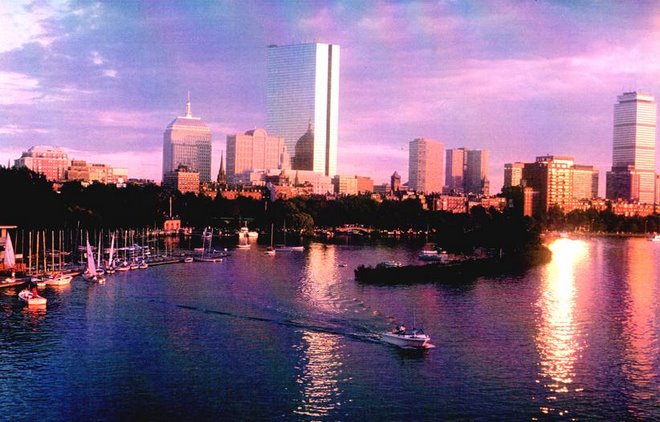
The Brattle Book Shop is one of Boston's finds. Here it is seen in its summer weekday glory.Sunday, November 18, 2007
Thursday, November 15, 2007
Blog Riotus Working Out
Wednesday, November 14, 2007
Blog Riotus joins Technorati
Technorati Profile
Welcome.
Tuesday, November 13, 2007
The Port Jefferson - Bridgeport Ferry
I tried using the West Cross/Merritt Parkways (Rt 15) that winds through wooded terrain with quaint stone bridges that span the roadway at intervals and parralels 95, but at times the volume clogs this route so completely traffic actually stops for long enough to open up conversations with fellow commuters. Not that I would actually do that, because although I was temporarily lulled by the pleasant scenery, the anger would be creeping back to life and no doubt any inane comments from a Fairfield County Connecticuter would send me into incessant road rage.

What must have saved my recommute was a simple boat ride. The ferry leaves from a midpoint in Long Island and shoves you off unceremoniously in Bridgeport, CT. It's not the staff, food, or tour of either port city that is worth the steep fare of passage, it's the clear peace of mind one gets without the stop-and-go dash that is the commute leaving from New York City into Connecticut on a friday evening. It's the sunset over New York City and sea air over the Long Island Sound that makes it worth it. I recommend it for anyone who needs to get off of "the island" on a friday night and dreads the Throgs or Whitestone commute.
War of Amputees
The toughness these wounded veterans display is beyond most people. Here they are missing arms in legs and yet they still keep a positive outlook. A female soldier from South Carolina who joined the Army to escape a future with two choices: to get married or to get out, said she never allows people around her to cry about her injury. "I will do that on my own time." Another soldier who lost an arm, and both legs (former boxer and gymnast) said that if he had all four amputated it would not be worth living, said that one arm allowed him the independence to take care of himself. Headwounds are the worst. With two headwounds, a soldier was left half incapacitated and left to the care of his mother for the rest of his life. When the blinded soldier struggling to place his false eye into his empty socket took the screen, I could not take it any longer.
This war has the most amputees since the Civil War and the mental devastation has been understated. The result will be inevitable; PTSD, homeless, and vets uncared for, the cost that survivors pay for after all wars. In five years, we forget their sacrifices, take away benefits and coverage and in doing so, remove their dignity. The elevated number of suicides by returning veterans is only the beginning. It's one thing to "Support the Troops" tooting horns and waving flags; it's another thing to support the troops in a meaningful way.
Sunday, November 11, 2007
There's a war going on now, does anyone care?
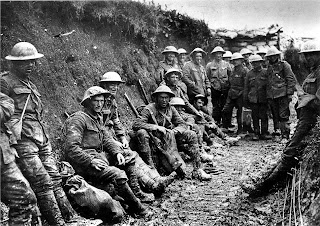
So when I happened to come across a blog (http://wwar1.blogspot.com/) on the internet about a soldier's letters sent to his wife and brother from the front in France, I was immediately interested. Pvt. Harry Lamin's letters are timeless and universal for all soldiers writing to loved ones back home. These letters are posted on the site by his grandson, exactly 90 years to the day after they were penned by Pvt. Lamin himself in the trenches. With exactly one year left to the day for the war, we aren't sure if Harry Lamin survives. A radio interview of Lamin's grandson discusses more on the postings.
In the trenches: Royal Irish Rifles in a communications trench on the first day on the Somme, 1 July 1916
While the war today is not being fought in trenches, there is probably a great similarity in the sentiments of those fighting and their families at home. I won't pretend to really understand the daily fear and traumatizing moments, but quote my father, "If people knew what wounds smelled like and had to pick pieces of their buddies flesh from their face, maybe they would not be so ambivalent about this war." At least the trench provided a safe haven for the troops at the front. In Iraq, everyday is like the green fields of the Somme. At any moment an explosion could tear their life away. There was an article in the Boston Globe today about Marines returning from the "front" in Iraq and the survey they answered from a Globe writer. I thought the most telling response was that the soldiers felt that more than a third of the Boston Metro community was either unappreciative or unaware of the returning vets service for our country in Iraq. This is the first war in which the home front has not been responsible for bearing any brunt of the suffering of the front lines. The war is shielded from our population, available only in relics of news coverage in newspapers or posted as headlines in the web. How many more stories on Britney Spears were there this year than on the War in Iraq? It is Veteran's Day tomorrow, and I hope some people remember to honor those who serve and have served our country in a way unimaginable to most people in our country today. Unfortunately, war has been a part of humanity since our beginnings and although I do not support war as a bright option of diplomacy, and certainly don't support our leader's decisions to invade Iraq, the soldiers should be recognized for their brave conduct and sacrifices.
There is another good article about Veteran's Day on more than 1200 squares named in honor of local veterans of foreign wars that we pass on by unknowingly on our daily lives. And just to know, Veteran's Day was November 11, formerly known as Armistice Day, the date which the guns of World War One went silent.
Friday, November 9, 2007
Will we get ours?
For a continent with so many natural resources, most are inaccessible without the investment of heavy machinery and excavation techniques. Oil and minerals have plentiful reserves on the continent, but the native people had no way of unearthing them. After centuries of development, the Europeans descended upon Africa in the 19th century with a fury, taking over land, enslaving people, destroying culture and imposing European “ways” on Africans. Of course, the average African was able to taste these refinements, without a doubt. Even though the European countries found the African landscape basically fruitless with no easy profits to show for it, their private companies got into the mix, settled in, and made a killing; literally. (In the end, many immigrants have flooded into the European nation escaping hunger, famine and war and this exodus has placed a burden on those nations. I guess you always get what you deserve.)
For something as obvious as the diamond trade causing such misery in these countries, it is a shame that “civilized” society still has a relentless demand for them. When I hear the local jeweler commercials on the radio and see them on the television, I wonder how our society in the future will survive when things change for the worst and we need to rely on each other and others to get by. For a regard so small for the rest of humanity, is there really a doubt whether other people will come to our aid? Maybe in the end, when we stood by and watched the purging of Darfur, and when we bled Africa dry for want of oil and diamonds etc., we will get what we deserve.